
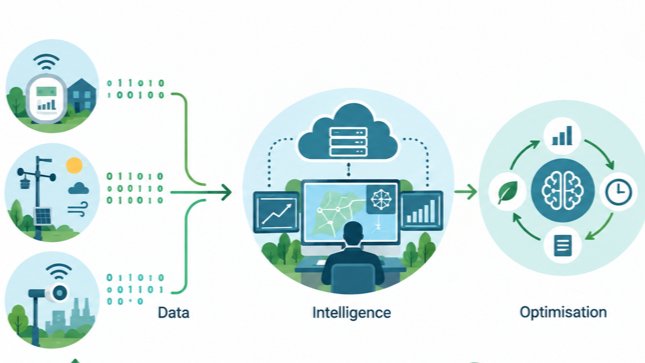
Digitalisation creates value when it supports better engineering and business decisions. For energy-intensive industries, the opportunity lies not simply in collecting more data, but in using operational information to improve reliability and efficiency, optimise maintenance, and support informed investment decisions.
The relevance of digitalisation varies across sectors. Utilities require greater visibility across networks and distributed energy resources; manufacturers need to reduce downtime and optimise energy-intensive processes; buildings require coordinated control of energy systems; transport operators rely on fleet and charging data; and data centres must manage power, cooling, reliability, and rapidly growing digital loads. A common challenge across these sectors is combining data from multiple sources into reliable information that operators can use to make informed decisions.
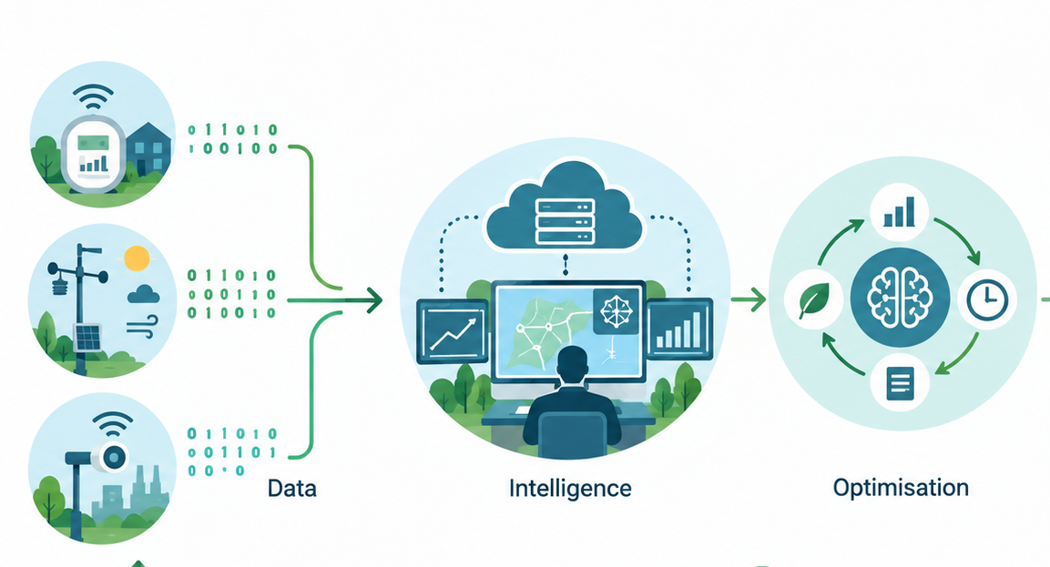
Figure 1. A simplified digital-energy flow: operational data is connected, analysed and translated into optimisation decisions.
Better visibility changes how industries operate
A digital system begins with measurement. Smart meters, inverter telemetry, building-management systems, production sensors, charging platforms and network devices can provide a detailed insight into energy use and asset condition. For example, (i) for manufacturers, these data can show how energy consumption relates to production output, (ii) for building owners, they can identify simultaneous heating and cooling, and (iii) for utilities, they can highlight areas where network constraints are developing.
However, having more data does not necessarily provide better visibility. Data must be timely, properly contextualized, and accessible to the teams responsible for operational decisions. Poorly integrated systems can leave organisations with large volumes of information without providing greater visibility or control.
Question for industry: Which operational decisions in your organisation are still being made with incomplete, delayed or disconnected data?
Forecasting and optimisation are becoming operational tools
Forecasting supports more informed planning when future conditions are uncertain. Renewable energy producers can use weather and generation data to forecast power output, while buildings and factories can forecast electricity demand. Logistics operators can anticipate charging requirements, and utilities can forecast network loading. These forecasts can then be used to optimise the operation of assets such as battery storage, flexible loads, generation systems, and charging infrastructure.
The strongest use cases vary according to operational needs. A factory may optimise production and energy schedules to reduce and manage demand. A commercial building portfolio may coordinate HVAC with electricity prices. A data centre may optimise cooling and power assets, while a fleet operator may schedule vehicle charging based on route requirements and grid capacity.
Question for industry: Where could improved forecasting help reduce costs, downtime, or operational uncertainty in your organisation?
AI can improve performance, but implementation barriers are real
Artificial intelligence (AI) can support forecasting, predictive maintenance, and operational optimisation, but its effective deployment depends on the quality of available data and the operating environment. IRENA's 2025 survey and stakeholder analysis on power system digitalisation identified several recurring barriers: (i) around 60% of respondents considered a shortage of skilled professionals a critical barrier, (ii) 55% identified data and interoperability challenges, and (iii) approximately 53% reported insufficient financial incentives and limited market readiness [1].
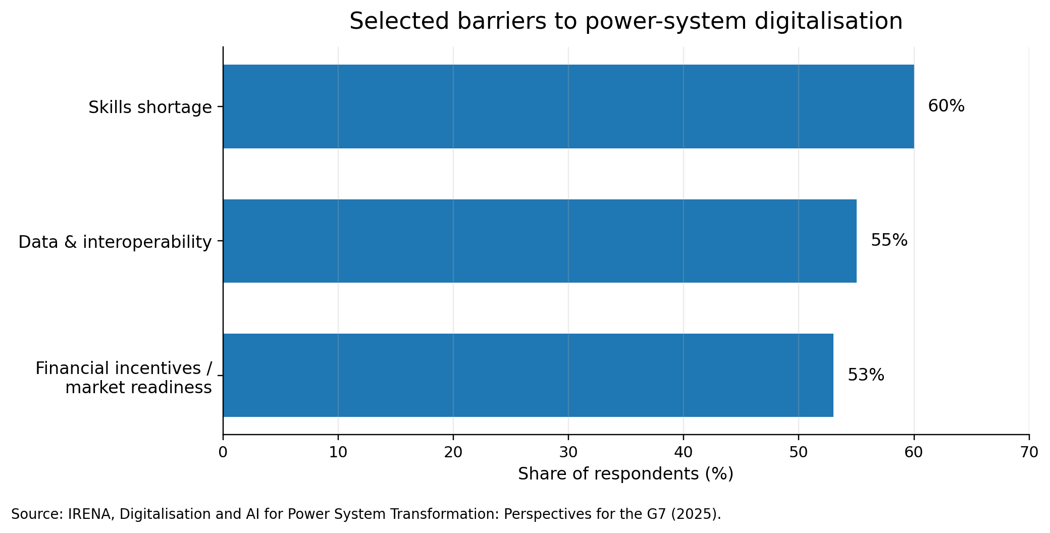
Figure 2. Selected implementation barriers identified by IRENA stakeholders. Source: IRENA, Digitalisation and AI for Power System Transformation, 2025 [1].
A high-performing AI model may still fail to deliver the expected results if data ownership is unclear, systems cannot exchange information, staff lack confidence in its outputs, or processes are not in place to act on its recommendations. For industry, successful AI adoption, therefore, requires organisational and engineering capabilities alongside effective software implementation.
Question for industry: Is your organisation ready to operationalise AI, or are data quality, skills, ownership and integration still the limiting factors?
Digital growth is creating new energy and infrastructure pressures
Digitalisation is changing electricity demand. IEA reported in April 2026 that global electricity consumption by data centres increased by 17% in 2025, while electricity use by AI-focused data centres increased by 50% [2]. For data-centre operators, this growth imposes pressure on power availability, cooling systems, energy storage, and grid connection. For utilities and municipalities, the concentration of large digital loads can affect network planning and local infrastructure investment. This forms part of a wider increase in electricity demand, with the IEA identifying industry and expanding data-centre capacity among the important drivers of global electricity-demand growth through 2030 [4].
The IEA’s 2026 energy and AI analysis highlights that AI can support more efficient use of existing grid capacity and improve the monitoring of transformers and other equipment [2]. These applications form part of the broader role identified for AI in energy-system operation and optimisation [3]. However, greater reliance on AI and connected systems can also increase cybersecurity risks and dependence on digital infrastructure [3].
Question for industry: If digital demand grows faster than physical infrastructure, how will your organisation manage power, cooling, and resilience requirements?
Cybersecurity and interoperability are operating requirements
As industrial and energy systems become more connected, cybersecurity risks increasingly extend into physical operations. Utilities, factories, building control systems, and distributed energy resources increasingly depend on software, communications networks, and remote access. A cyber disruption can therefore affect not only information systems but also production, energy availability and operational safety.
IRENA identifies data governance, interoperability and cybersecurity as important requirements for digital power systems. IRENA 2025 stakeholder survey found that around 71% of respondents recognised the need for close coordination among different actors when defining cybersecurity measures for power grids [1]. For industry, greater digital connectivity requires stronger access controls, secure operational networks, reliable data management, and backup procedures to maintain essential functions during system disruptions.
Question for industry: Are your connected energy and operational technologies designed so that a digital failure does not become an operational failure?
Digitalisation should start with the problem, not the technology
Not every site requires the same level of automation, AI, or connectivity. An effective digital strategy should begin with a clearly defined operational problem, such as excessive energy consumption, avoidable downtime, limited system visibility, network congestion, maintenance risks, or slow decision-making. Only then should the organisation decide what data, communications, analytics and level of automation are required to address that problem.
This approach also provides a clearer basis for investment decisions by linking technology deployment to measurable outcomes. Digitalisation can then support engineering and business performance rather than being treated as a separate transformation programme.
Question for industry: Which measurable operational problem should digitalisation solve first in your organisation?
Key terms
Digitalisation: the use of connected data, communications systems, and software to monitor, analyse, and control physical processes.
Artificial intelligence (AI): data-driven computational methods used for classification, prediction, optimization, and automated decision support.
Interoperability: the ability of devices, platforms and organisations to exchange and use data through compatible standards and interfaces.
Predictive maintenance: a maintenance approach that uses asset condition data and analytics to identify signs of deterioration and potential failures before they occur.
References
1. International Renewable Energy Agency (IRENA), Digitalisation and AI for Power System Transformation: Perspectives for the G7, October 2025. https://www.irena.org/Publications/2025/Oct/Digitalisation-and-AI-for-power-system-transformation-Perspectives-for-the-G7
2. International Energy Agency (IEA), Key Questions on Energy and AI, April 2026. https://www.iea.org/reports/key-questions-on-energy-and-ai
3. International Energy Agency (IEA), Energy and AI, 2025. https://www.iea.org/reports/energy-and-ai
4. International Energy Agency (IEA), Electricity 2026, February 2026. https://www.iea.org/reports/electricity-2026
Explore related expertise
Learn about data management, digital twin solutions and energy management. Read Digitalization and operating risk for the governance and resilience questions behind connected systems.