
A company may promise to cut emissions, close old factories or invest in cleaner technology to match ongoing sustainability commitments. If those plans could change what the business owns, earns or spends, the financial statements should reflect them. If the climate plan and the financial statements point to different futures, the company should explain why.
Why climate plans matter to the Company’s financial statements
There is no separate International Financial Reporting Standards (IFRS) rulebook for climate change. However, existing accounting standards still require companies to consider climate-related matters when they could significantly affect the financial statements. To clarify how those requirements apply in practice, the International Accounting Standards Board (IASB) has published examples dealing with climate-related uncertainty.
The idea is simple. A company’s financial statements rely on estimates about the future. Climate plans may change how long a factory will stay open, how much money it will earn, whether customers will keep buying its products and how much it will cost to close or clean up a site.
How the two stories drift apart

Suppose a company says it will close a factory in 2035 according to its sustainability initiatives. Its financial statements still assume that the factory will operate and earn money until 2050. A reader will naturally ask why the dates are different. There may be a good reason, but the company should state it clearly.
Some companies explain how climate plans affect their estimates. Others say that they have included their net-zero plans in their forecasts but that climate change has no important financial effect. Both statements may be true. The report should explain how they fit together.
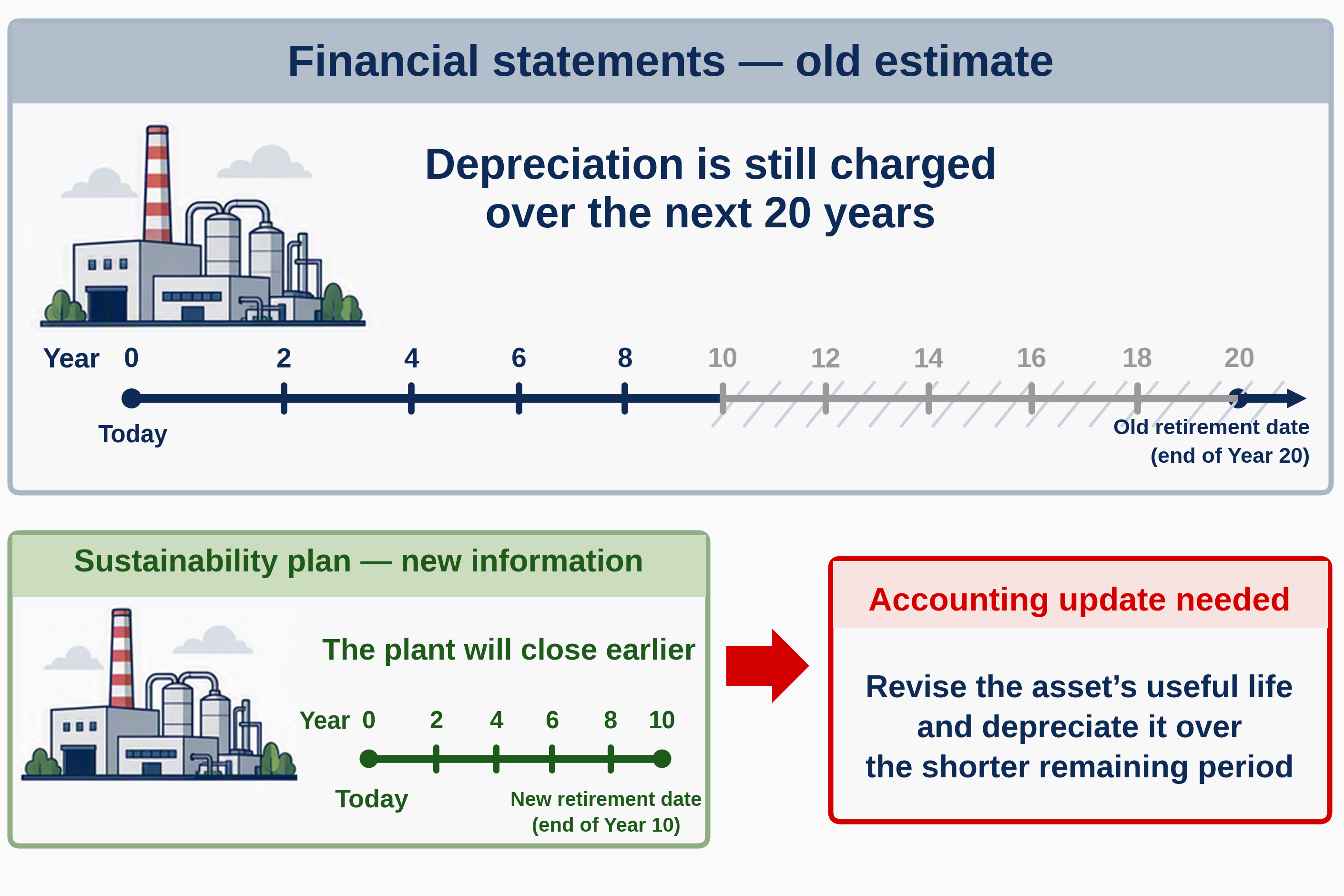
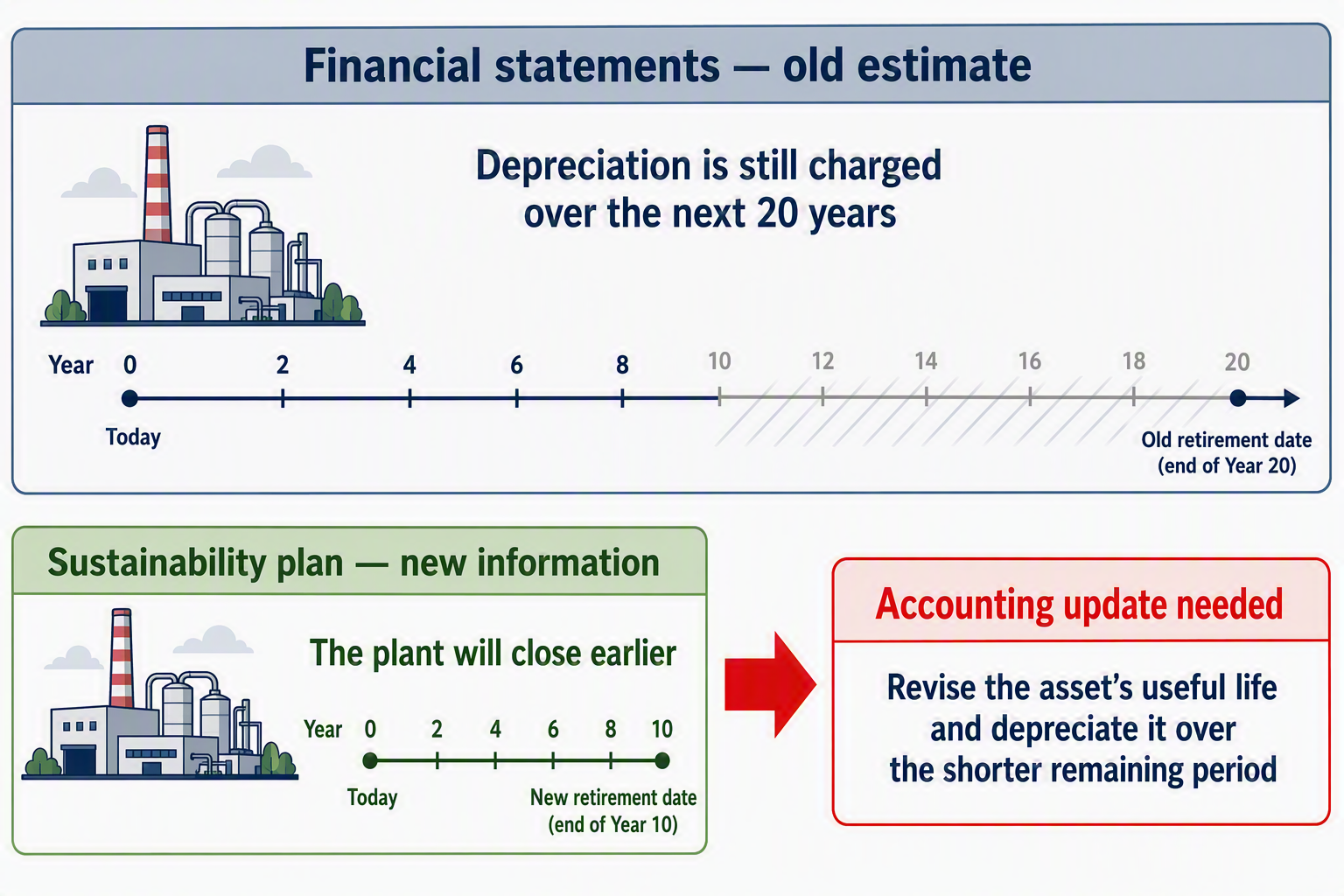
The financial statements still depreciate the plant over 20 years, but the sustainability plan brings forward its closure. The asset’s useful life should therefore be revised and depreciation charged over the shorter remaining period.
Why regulators are interested
Investors want to know whether a company’s numbers support the promises made elsewhere in its annual report. Regulators want the same. The European Securities and Markets Authority (ESMA) has asked companies to explain differences between climate commitments and the assumptions used in their financial statements. ESMA reviews have looked at asset values, the expected life of assets and future costs, as well as cash-flow forecasts.
What could change in the financial statements?
A factory or machine may be worth less. Its value depends partly on how much money it is expected to generate. Demand may fall, carbon costs may rise or new equipment may be needed. If expected earnings fall, the company may have to reduce the asset’s value. Accountants call this an impairment.
The company may need to record the asset’s cost over fewer years. For example, if a factory was expected to operate until 2050 but will now close in 2035, the company should spread its remaining cost only up to 2035. This means recording a higher expense each year. However, cleaner technology may sometimes allow an asset to be used for longer.
The company may face future costs. It may need to close a site, clean up land or end a loss-making contract. A public net-zero promise does not automatically create a liability. A cost is recorded only when the company already has an obligation that it cannot realistically avoid. Other possible costs or risks may still need to be explained.
In plain words, the same three questions come back each time: what is the asset worth, how long will it be used, and what will it cost to stop using it. If the climate plan changes the answer to any of them, the figures should change with it, and the notes should say so.
A company that tells one story: Enel

Enel, the Italian power group, has promised to close all of its remaining coal plants by 2027 and to reach zero emissions by 2040. After a dialogue with investors, it published a dedicated coal section in its 2023 sustainability report, setting out a closure date for each plant and the conditions that could delay it, such as a regulatory authorisation or a new transmission link. Its investor material repeats the same detail plant by plant.
That is exactly what an accountant needs. A closure date gives the remaining life over which a plant should be written down, a reason to test its value, and a basis for estimating the cost of closing the site.
The regulator has looked at this too. Reviewing the 2022 annual reports of European companies, ESMA chose Enel as one of its illustrations of how climate matters were explained inside the financial statements — under significant judgements and estimation uncertainty, covering the impairment test, useful lives and provisions. ESMA did not say that Enel’s disclosures were best practice. It used the example to show that clear details about plant closure dates and conditions can help explain the estimates used in the financial statements.
When “no impact” is the honest answer
Climate plans may have no important effect on this year’s figures. That can be a reasonable conclusion. But when a company has announced a major transition plan, readers may still need a short explanation of what management considered and why no change was needed.
A question of governance, not just accounting
Sustainability teams often prepare climate plans, while finance teams prepare the financial statements. If the two teams use different dates, costs or business assumptions, the annual report may tell two different stories by accident. Management should agree the main assumptions and keep a clear record of the reasons behind them.
The questions that reveal most
Management should ask two simple questions.
Do the climate report and the financial statements describe the same future for the business?
Which climate assumption could have the biggest effect on asset values or future costs?
A difference does not automatically mean that the financial statements are wrong. There may be a valid reason. But the reason should be clear and supported by evidence. Readers should not have to guess whether the climate promise or the financial figures show the company’s real plan.
Where experienced reporting advice adds value
An experienced adviser can bring finance and sustainability teams around the same set of assumptions. Climate commitments can be translated into the figures that shape the financial statements, for instance closure dates, production volumes, carbon costs and site-restoration costs and tested well before year-end. Where the two stories diverge, the adviser can help management document the judgement, support it with evidence and explain it clearly in the financial statements. Early alignment is a modest investment compared with the cost of answering difficult questions from auditors, regulators or investors later.
Explore related expertise
Learn about our sustainability reporting alignment and financial modelling and forecasting services, or explore how industrial energy investment decisions connect operations, sustainability and long-term value.