
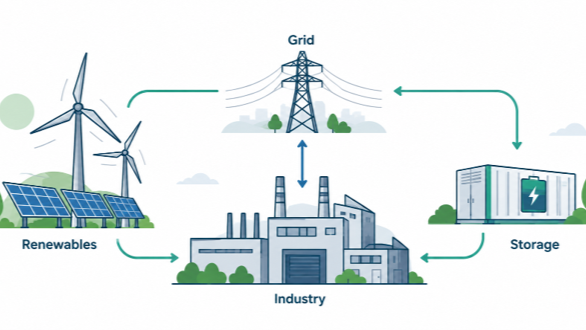
The next phase of the energy transition is not simply about adding renewable capacity. For industry, the real question is how to secure reliable, affordable and lower-carbon energy as grids, demand and operating requirements continue to evolve.
Manufacturing plants, data centres, transport operators, commercial buildings and utilities do not experience the energy transition in the same way. A manufacturer may be concerned with electricity prices, process heat and production continuity; a data centre with connection capacity and power quality; a logistics operator with charging infrastructure; and a property owner with efficiency, electrification and compliance. This is why sustainable energy is increasingly an industry design challenge rather than simply a choice of technologies.
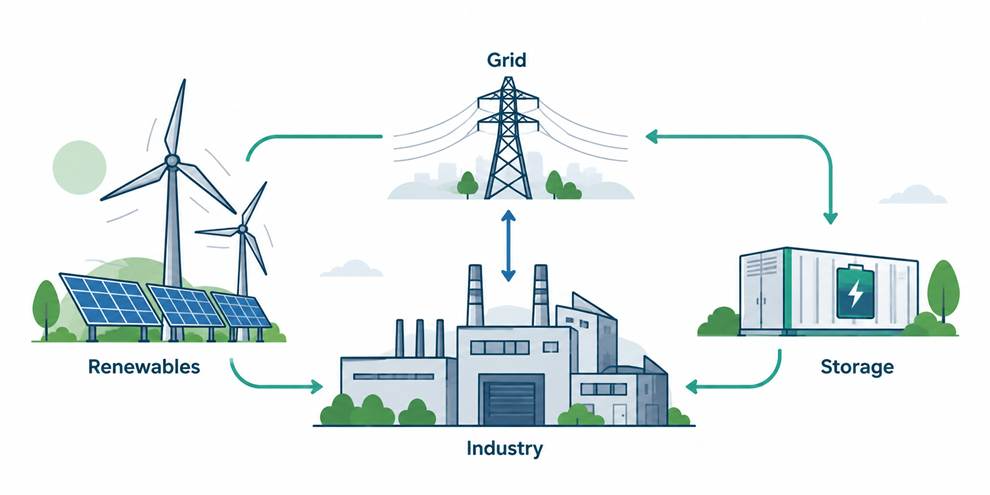
Figure 1. A simplified view of the industrial energy system: renewable supply, grid infrastructure, storage and industrial demand.
Industry Energy Needs Are Changing
Across sectors, energy is becoming a strategic operating issue. Electrification, volatile energy prices, decarbonisation requirements, and new digital loads are changing electricity demand patterns. Manufacturing and processing industries need predictable costs and a reliable energy supply; buildings face growing electrification and efficiency requirements; transport operators require adequate charging capacity; data centres create concentrated and rapidly growing electricity loads; and utilities must integrate new generation while maintaining system stability.
In practice, energy planning can no longer be separated from investment decisions, operations, and resilience. An organisation expanding production, electrifying its fleet, or opening a new digital facility may find that the main constraint is not the availability of equipment, but whether the local energy system has sufficient capacity to meet demand when needed.
Question for industry: Which energy constraint is most significant for your sector today: cost, grid connection capacity, reliability, decarbonisation requirements, or future demand growth?
Renewable capacity is growing, but integration is the next step
The International Renewable Energy Agency (IRENA) reports that global renewable power capacity reached 5,149 GW by the end of 2025, compared with 3,077 GW in 2021 [1]. This rapid growth is significant for electricity-intensive sectors, but adding renewable capacity alone is not enough. New renewable generation can deliver its full value only when grids, energy storage, and demand are able to accommodate and use the available power when it is needed.
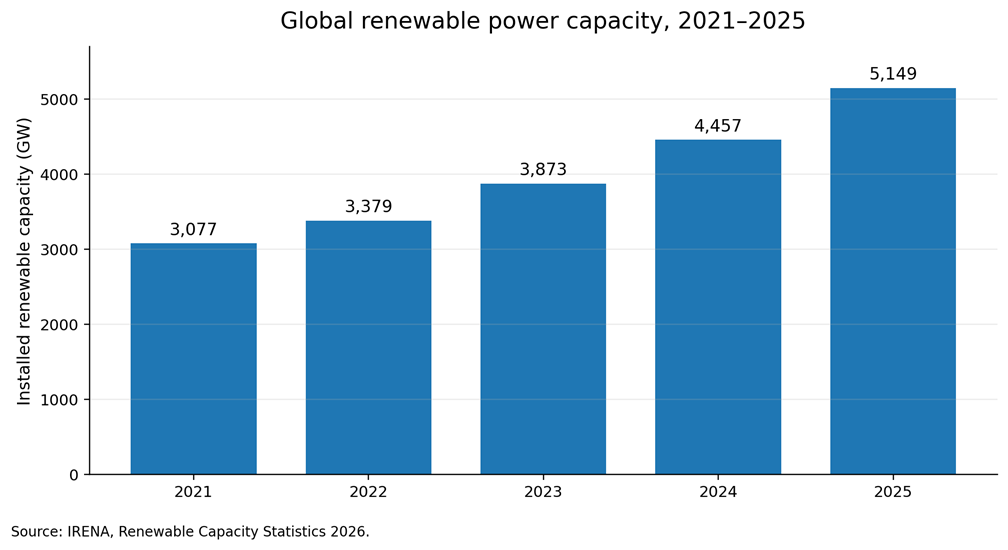
Figure 2. Global renewable power capacity, 2021-2025. Source: IRENA, Renewable Capacity Statistics 2026.
For industrial users, this changes the question from “Can we procure renewable energy?” to “Can the energy system meet our operational needs?” A site with variable production, sensitive loads, or limited grid capacity may require a different mix of on-site generation, energy storage, supply contracts, demand flexibility, and efficiency measures than a conventional office or retail facility.
Question for industry: Is your organisation planning renewable procurement and electrification alongside grid capacity, operating profiles and future demand?
Grid capacity is becoming a business constraint
Grid access is now directly affecting project schedules and investment decisions. The European Commission reports that, by mid-2026, at least 16 EU Member States had projects waiting for grid connections, with around 120 GW of mature renewable projects, including approximately 1.5 million household installations, at risk of connection delays by 2030 [2]. The European Commission’s 2025 guidance indicates that these delays result from several factors, including inadequate network planning, delays in grid development, limited transparency regarding available capacity, and connection procedures that do not adequately prioritise project maturity [3].
These constraints are particularly relevant to manufacturing expansions, large commercial developments, electric-vehicle charging facilities, and data centres, where increased electricity demand may require both a new grid connection and reinforcement of the existing network. In some cases, the planned facility may be ready for operation several years before the necessary network upgrade.
Likewise, International Energy Agency (IEA) reports in Electricity 2026 that more than 2,500 GW of generation, energy storage, and large-load projects remain delayed in grid-connection queues worldwide. This highlights the importance of assessing grid capacity and connection requirements at an early stage of project development [4].
Question for industry: Could limited grid capacity affect where, when, or at what scale you make your next major investment?
Storage and flexibility are changing the design of industrial energy systems
Battery energy storage and demand response can help organisations shift electricity consumption across time, reduce peak demand, and increase the use of available renewable generation. However, the potential benefits vary across sectors. A factory may reschedule selected processes or use battery storage to limit demand peaks; a logistics hub may optimise fleet charging; a building portfolio may coordinate HVAC and thermal loads; and a data centre may combine battery storage with flexible operating strategies where service requirements allow.
The value of flexibility is therefore determined by its operational benefits rather than by the technology alone. The key question is whether controllable loads and energy storage can reduce costs, improve resilience, or avoid costly grid reinforcement without disrupting core business operations.
Question for industry: Which loads in your operations are genuinely flexible, and what value could storage or demand response create before new infrastructure is added?
Sustainability extends beyond operational carbon
Sustainable energy decisions have lifecycle consequences. Solar modules, batteries, transformers, charging infrastructure and digital equipment require materials, manufacturing, transport, maintenance and end-of-life management. For industry, this means that energy investment decisions must consider resource efficiency, circularity, supply-chain resilience, and climate resilience alongside carbon reduction.
An option with a lower initial capital cost does not necessarily carry the lowest risk over a 15 or 25 year asset life. Equipment availability, replacement cycles, exposure to extreme heat or flooding, recycling routes, and dependence on critical materials can all affect long-term performance and cost.
Question for industry: Are your energy investments assessed only in terms of initial cost and emissions, or do you also consider lifecycle performance, supply-chain risks, and climate resilience?
From capacity to competitiveness
For industry, the energy transition is increasingly becoming a matter of competitiveness. The best organisations positioned to benefit will be those that connect energy strategy with operations, capital planning and risk management. This requires considering renewable generation, grid infrastructure, energy storage, demand flexibility, and efficiency as interconnected elements of the energy system, and selecting a combination that reflects the specific requirements of each sector and site.
The next stage of sustainable energy is therefore less about installing more equipment and more about engineering systems that work under real operating constraints.
Question for industry: What would a reliable, lower-carbon, and cost-effective energy system look like for your organisation over the next five years?
Key terms
GW (gigawatt): A unit of electrical power equal to one billion watts.
Curtailment: A reduction in electricity generation when the power system cannot use or transmit all of the available electricity at a given time.
Demand response: The shifting or reduction of electricity consumption in response to grid conditions, electricity prices, or operator signals from grid operators.
References
[1]. International Renewable Energy Agency (IRENA), Renewable Capacity Statistics 2026, March 2026. https://www.irena.org/Publications/2026/Mar/Renewable-capacity-statistics-2026
[2]. European Commission, European grids – Grid connections, updated 2026. https://energy.ec.europa.eu/topics/infrastructure/european-grids_en
[3]. European Commission, Guidance on efficient and timely grid connections (Commission Notice C/2025/6703), 19 December 2025. https://eur-lex.europa.eu/eli/C/2025/6703/oj/eng
[4]. International Energy Agency (IEA), Electricity 2026, February 2026. https://www.iea.org/reports/electricity-2026
Explore related expertise
Explore our sustainable energy solutions and financial modelling and forecasting services. Read From Connected Assets to Better Industrial Decisions for the role of operational data in energy planning.